Wednesday, July 16, 2025

Back Again: An Often Told Lie

The past three years have been busier work- and extracurricular-wise than is healthy or normal. I've been stretched beyond belief in every part of my life, and my mental health has obviously taken a major hit. But more importantly, and less forgivable for sure, my ability to get any proper reading done has been basically nonexistent.

Over the past few years, I've read maybe 20 books tops a year. For someone who used to get through about 100 over the course of a year, it's been rough. What I have finished this year so far: mostly murder mysteries, and most of them poorly written at that. 


Re: my nonfiction reads: Everest, Inc. by Will Cockrell was pretty enjoyable. I find the audacity of climbing the 8,000ers very intriguing and take a morbid interest in when it all goes wrong. The book did a really good job of explaining how Everest went from a forbidding peak to a standard CEO bucket list item. Less juicy of a "look at these idiots paying thousands to die on a mountain" take than I was expecting, and more nuts and bolts about how these expedition companies started and, in good news, how the sherpas have started taking up more space in the money-making aspect. I'm still not sure whether I think the 'pros' of commercializing the mountain outweigh the cons (environmentally definitely a bad state of affairs, but commercialization -> fewer people die in preventable ways, like with better weather forecasts, etc., and shouldn't I be all about human progress and exploration?). But definitely a good read to get information that's not clickbait-y.


Tuesday, February 15, 2022

Bleak House: Lightning Round

 I blazed through Bleak House back in January, and while I thoroughly enjoyed it (I'm a fool for convoluted plots and way too many characters), there weren't really many deep questions or musings I had about it. So here's the lightning round of my thoughts:

1. I was expecting arcane legal jargon. I was not expecting spontaneous combustion.

2. John Jarndyce yeeting the food out of the carriage after Esther says she doesn't want it makes me laugh. What a moment to be extra.

3. I loved Mr. Guppy because he's such a tool; in my head, he's basically Jean-Ralphio from "Parks and Recreation."

4. I think I'm a Plantagenet Palliser, but I'm probably just a Mrs. Jellyby.

5. Frankly, someone should have beaten Harold Skimpole senseless years ago.

6. We need more gentlemen of deportment who take it upon themselves to show that deportment to the masses.

7. John Jarndyce:

"I'm the legal guardian for this teenage girl."

"I'm her employer now that she's an adult."

"I'm totally in love with her." 

NO.

8. Fallen Woman Dies Because She's a Fallen Woman Disease strikes again.

Tuesday, February 8, 2022

Daniel Deronda: Hateful Female Characters; Is George Eliot Cringey?

It took me longer than I wanted it to, but I finally finished reading George Eliot's Daniel Deronda. My winter reading list is Victorian literature, and I'd put Middlemarch down, since it's one of ~the~ 19th century novels. However, the library did not have it, so I went with the only Eliot novel on the shelf. The only thing I'd known about the book before was that the main character wears a gorgeous red-orange gown with an ivory jacket in an archery scene in the 2002 miniseries.

Overall, it was a pretty decent read, even if we didn't really need the last 20 or so pages.

Anyways, things that stood out to me:

Hateful Female Characters

Call it internalized misogyny or just me paying more attention to female characters because I too am female, but I am very good at hating women in literature. And I have to say, I really hated Gwendolen Harleth. The way she automatically sneers at all the other young women in the village and immediately writes all of them off as being intrinsically inferior to her is repulsive. Same for how she views her younger sisters as non-entities because ... they're normal teenagers and one of them seems to have either bad posture or something wrong with her shoulders. And let's not forget that her initial dislike of Mr. Lush and wanting to avoid him is because he's ugly. That it takes her entering into an emotionally abusive marriage to make her improve is pathetic and speaks to the lack of moral fiber she has. I don't think I buy her ~becoming a better person~ thing either; to me, it seems like she was just really infatuated with Daniel Deronda (in a very selfish way at that; who sends a letter to their crush on their wedding day?). 

I also saw some parallels between the way she treated and manipulated others with how Grandcourt treated her, albeit he's a lot more cruel than she is. Eliot even makes a reference to her knowing that she can't complain that much about his treatment of her seeing as she planned to manipulate and control him in their marriage. 

So basically the chapter in which Klesmer brutally informs her that she has no real artistic talent was absolutely delicious to me.

BUT let's not ignore her creepy enabling uncle, Gascoigne. This guy is a total social climber - he changed his last name from the boring Gaskin to the fancier sounding Gascoigne. Eliot mentions how he spends more time hobnobbing with more socially advantageous people than focusing on the poor and their needs like a minister ought to. And he is so, so weird about Gwendolen. He totally prioritizes her over his own daughter Anna, as well as criticizing Anna while praising Gwenny H in front of them both; in the archery ball scene when she's trying to be ~unique~ by not dancing the waltzes and polkas, the text mentions how he totally wants her to be distinguished in everything. Dude, stop obsessing over this one niece and start caring about your own family more, you weirdo. His losing his money due to bad investments felt well-deserved. While he's still going to get invited to stuff by the ~right kind of people~ because he's a rector, he's definitely going to feel the differences in status more acutely. Serves him right. [I suspect that he's so concerned with her making an advantageous marriage not just because it'd help her family out, but that he might benefit from it too.]

Side note: I do however like that Gwendolen is put off by the thought of marriage because of the sacrifices on the part of women that she's seen up close with her own mother's miserable second marriage (Davilow is an awesome last name, however) and that she wants to be able to do whatever she wants. The school I went to was always harping on about how it's women's spiritual role to sacrifice for their families, etc., etc., and I naturally developed the same attitude as Gwendolen.

Is George Eliot Cringey?

There are some critics who think the "Gwendolen" content is better than the "Daniel" chapters; apparently one commentator back in the day went so far as to suggest the novel be improved by cutting all the Daniel content and calling it "Gwendolen Harleth" (but I'm pretty sure that was because that person was an anti-Semite). I wouldn't go so far as that, but a lot of the Daniel content feels ... off. Like Eliot is trying too hard. Especially with Mirah's tale of epic melodrama, suffering, and struggles against her corrupted father. Granted, the Victorians were all about the melodrama and virtuous heroines. But for some reason, it seems like Elliot was trying too hard to make Mirah the perfect heroine, above approach in all ways. Granted, she was probably doing this deliberately so no prejudiced readers could find fault with a Jewish protagonist. Still, to modern eyes, it still feels so cringey. If Eliot were alive today, she'd totally have one of those "In this house, we..." yard signs while sending her kids to private school. [This Guardian article says "her portrayal of the innocent Mirah swings the other way, so saintly it has shades of the noble savage." Pretty much.]

Ditto with Elliot lacing practically every single language with references, both well-known and obscure, to the Torah and Jewish history to show that she alone amongst the goyim knows Jewish culture. [mostly unrelated: George Eliot always strikes me as one of those "I'm not like other girls; I'm one of the boys" women] By all means, I applaud her for A) not accepting the ingrained antisemitism of her day and wanting to make a stand and B) doing research and becoming familiar with Jewish history. But it does come across very heavy-handed, especially for a modern audience. In trying to show the Jewish characters as belonging to a venerable, illustrious, and fascinating culture worthy of society's respect, it came across as her robbing them of their agency by making them more of "characters" than individual, fully fleshed people. Or at least that's how it seemed to me. Which is a shame, because I don't think I've come across many Jewish characters in British literature who we're supposed to root for before. 

Also, she isn't above using some anti-Semitic tropes herself in trying to show Daniel's initial prejudiced assessment of the Cohen family - she makes them out to be money-grubbing and even refers to Ezra Cohen as oily. [I also suspect that Eliot didn't have much regard for normal non-intellectual types, but I have nothing to back that up with since I've only read Silas Marner (the kid's hair color is symbolic for the lost gold, groundbreaking) and The Mill on the Floss (hello, sibling incest vibes) and don't know that much about Eliot herself.]


Monday, August 8, 2016

Two Tech Books; One Clear Winner

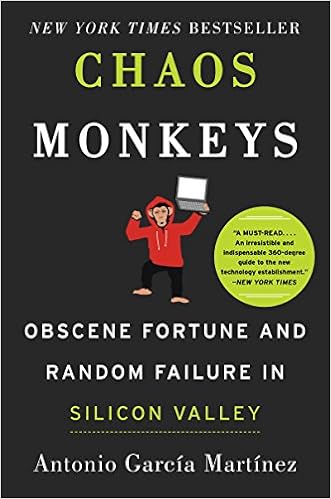
In addition to reading sea tales this summer, I've made a brief venture into tech reads with Antonio Garcia Martinez's Chaos Monkeys: Obscene Fortune and Random Failure in Silicon Valley and Dan Lyon's Disrupted: My Misadventure in the Start-Up Bubble.

image via Amazon

Chaos Monkeys is about Martinez's experiences getting into advertisement strategy and working in Silicon Valley. He switches his career as a quantitative analyst at Goldman Sachs for at a stint at Adchemy. He later forms a start-up called AdGrok, sells it to Twitter, and then works for Facebook before getting fired.

Disrupted retells Lyons' venture into Hubspot after getting laid off from Newsweek. For a self-styled cynical journalist, the inbound-advertising company is part nightmare, part bizarre anthropological expedition. He navigates an unfriendly office culture that's completely different from the journalism field and which favors youth over experience because of costs. Eventually, he gets a job as a screenwriter for HBO's Silicon Valley and later leaves Hubspot for the now-defunct ValleyWag. He also becomes the intended victim of cybercrime when his Hubspot boss attempts to get hold of the manuscript before publication; Lyons discusses this at the end of the book.

The reactions I had to the books were polar opposites. Disrupted I thoroughly enjoyed; Chaos Monkeys I loathed. But why?

Chaos Monkeys' narration is so repulsive. Martinez insists on adopting a smug, bitter persona throughout the entire book. Reviewers on other platforms have referred to it as imitating gonzo-style journalism (I can't weigh in, as I know little about that writing style). At any rate, he routinely rips down other people and their accomplishments in Chaos Monkeys. He's an insufferable pseudo-intellectual and makes a point to throw in as many references and quotes from philosophical texts and world history as possible, even when it adds no value to his work. (Note: I'm a total tool when it comes to this sort of thing, and even I'm not as obnoxious as Martinez.)

We also get to see him show off what a terrible parent he is; after fathering two children, he decides to walk out of their lives because the idea of having a normal relationship with his family is too bourgeois for him to consider (why would you flaunt your personal failings and the sad details of your children's private lives like that??).

But the worst part of Chaos Monkeys is the rampant sexism. Descriptions of women that don't reduce them to sex objects or completely belittle them are the exception, not the rule.

For example, take the following passage:
"Most women in the Bay Area are soft and weak, cosseted and naive despite their claims of worldliness, and generally full of ****. They have their self-regarding entitlement feminism, and ceaselessly vaunt their independence, but the reality is, come the epidemic plague or foreign invasion, they'd become precisely the sort of useless baggage you'd trade for a box of shotgun shells or a jerry can of diesel."
He dismisses the former Business Insider editor and UPenn-educated Courtney Comstock as a reporter with a "porn star name." In discussing Tech Crunch's legitimate concern about sexism in Silicon Valley, he smirks about how they're always "agonizing" over it. He can't even simply concede the fact that a woman came up with a better idea for putting ads on Facebook than he did; he has to spend time describing her wardrobe (I guess because French women who dress fashionably aren't supposed to be as competent?), accuse her of being a social climber at Facebook, and hint that her ideas weren't valid.

Of course, his miserable persona was a deliberate choice. It's meant to create buzz about his book that otherwise might not exist.

image via Amazon

My take on Disrupted was much different. I found some fault with his attitude; he does sound rather arrogant time to time (especially in regards to going from respected journalist to tech newcomer), and his inability to grasp the consequences of what one posts on social media is baffling. But overall, the narrative is an entertaining one. He finds a lot to criticize at Hubspot, but the tone is less one of Olympian disdain and more that of genuine shock and confusion. In particular, his allegations of age discrimination are kind of horrifying, such as coworkers calling him "Grandpa Buzz" and the company's CEO saying in a New York Times interview that Hubspot actively prioritizes hiring young people and thinks work experience is overrated.

I may also be biased. I'm a young curmudgeon who generally eyes everything targeting the youth demographic with suspicion, and Silicon Valley is one of my favorite TV shows.

I'm pretty disappointed that Chaos Monkeys was so foul. It was more informative about the tech start-up world and its players than Disrupted. Had it been written by someone other than Martinez, it probably would have been a much better book. Disrupted is an actual story; Chaos Monkeys comes across as the literary equivalent of this Onion article.

Monday, August 1, 2016

Epilogue

 and I only am escaped alone to tell thee -- Job
 The drama's done. Why then here does anyone step forth? -- Because one did survive the wreck. It so chanced that after the Parsee's disappearance, I was he whom the fates ordained to take the place of Ahab's bowsman, when that bowsman assumed the vacant post; the same who, when on the last day the three men were tossed from out of the rocking boat, was dropped astern. So, floating on the margin of the ensuing scene, and in full sight of it, when the half-spent suction of the sunk ship reached me, I was then, but slowly, drawn towards the closing vortex. When I reached it, it had subsided to a creamy pool. Round and round, then, and ever contracting towards the button-like black bubble at the axis of that slowly wheeling circle, like another Ixion I did revolve. Till gaining that vital centre, the black bubble upward burst; and now liberated by reason if its cunning spring, and, owing to its great buoyancy, rising with great force, the coffin lifebuoy shot lengthwise from the sea, fell over, and floated by my side. Buoyed up by that coffin, for almost one whole day and night, I floated on a soft and dirge-like main. The unharming sharks, they glided by as if with padlocks on their mouths; the savage sea-hawks sailed with sheathed beaks. On the second day, a sail drew near, and picked me up at last. It was the devious-cruising 'Rachel', that in her retracing search after her missing children, only found another orphan.
-- Herman Melville, Moby Dick

Sunday, July 31, 2016

Loomings


Call Me Ishmael. Some years ago -- never mind how long precisely -- having little or no money in my purse, and nothing particular to interest me on shore, I thought I would sail about a little and see the watery part of the world. It is a way I have of driving off the spleen, and regulating the circulation. Whenever I find myself growing grim about the mouth; whenever it is a damp, drizzly November in my soul; whenever I find myself involuntarily pausing before coffin warehouses, and bringing up the rear of every funeral I meet; and especially whenever my hypos get such an upper hand of me, that it requires a strong moral principle to prevent me from deliberately stepping into the street, and methodically knocking people's hats off -- then, I account it high time to get to sea as soon as I can. 
- Herman Melville, Moby Dick